Showing posts with label 2. Analysis Phase. Show all posts

Friday, May 28, 2010

Historical Division between "Logical thinking" and "Visuals"

Rudolf Arnheim suggested a historical division between "Logical thinking" and "Visuals" in his ground-breaking book, Visual Thinking (1969). He pointed out that philosophers in ancient Greek credited the direct vision as the start and end source of wisdom although they also learned possible distortion in human’s visual perception (Arnheim, 1969. pp. 12).
However, hundreds of years later, the potential of using sketching in creative problem solving are still paid less attention. Sketching is often not considered as a form of thinking. In his book, Visual Thinking, Arnheim (1969. pp. 2-3) reflected on the issue as the followed:

“Today, the prejudicial discrimination between perception and thinking is still with us. We shall find it in examples from philosophy and psychology. Our entire educational system continues to be based on the study of words and numbers … More and more the arts are considered as a training in agreeable skills, as entertainment and mental release. As the ruling disciplines stress more rigorously the study of words and numbers, their kinship with the arts is increasingly obscured, and the arts are reduced to a desirable supplement…. The arts are neglected because they are based on perception, and perception is disdained because it is not assumed to involve thought. In fact, educators and administrators cannot justify giving the arts an important position in the curriculum unless they understand that the arts are the most powerful means of strengthening the perceptual component without which productive thinking is impossible in any field of endeavor. The neglect of the arts is only the most tangible symptom of the widespread unemployment of the senses….”

Nowadays, most of us still follow similar path in contemporary educational system and are serious about producing solutions in neat computer graphics or a profound report. But Visual Thinking, as a young facilitation method in group sessions, begins to bridge the creative qualities of instant sketches in business practice.

An idea of individual visual thinking process

An idea of Individual visual thinking process has been suggested by Rober H. Mckim in the book, Experience in Visual Thinking (1972).

"The overlapping circles can be taken to represent a wide variety of interactions. Where seeing and drawing overlap, seeing facilitates drawing, while drawing invigorates seeing. Where drawing and imagining overlap, drawing stimulates and expresses imagining, while imagining provides impetus and material for drawing. Where imagining and seeing overlap, imagination directs and filters seeing, while seeing, in turn, provides raw material for imagining. The three overlapping circles symbolize the idea that visual thinking is experienced to the fullest when seeing, imagining, and drawing merge into active interplay." (Mckim, R.H. 1972. p.6)

He pictured the activities, whether they are “perceptual, inner, and graphic images”, as three kinds of visual imagery: “Seeing”, “Imaging”, and “Drawing”. The three are interacted in a fluid and dynamic way practiced as an active interplay. People keep cycling through the overlapped visual imagery until the problems are solved. And this is a nature of people when a truck driver is driving through a busy traffic, when a football coach considers a new strategy, when a lady plans what to wear, and when an architect describes a new concept to his client.

"Visual Thinking pervades all human activity, from the abstract and theoretical to the down-to-earth and everyday." (Mckim, R.H. 1972. p.6)

This idea can be compared with the one proposed by Dan Roam in the book, The back of the Napkin.

Monday, May 24, 2010

Proposed focus for Contextmapping Research

Human interactions in Visual Thinking process in group sessions are suggested as the focus of 3. Contextmapping research.

We want to know how Visual Thinkers respond to the dynamic and diverse reality, such as different backgrounds of participants, and different issues, should gain further studies. Visual Thinkers have to utilize their experience to interact with the dynamic context properly and quickly. The interactions in Visual Thinking process are still unclear although it is crucial factor to a successful Visual Thinking session.

Learned from the discussion in the previous post and 2. Analysis, the missing puzzles in preceding studies are the stages, “personal insights” and “shared vision”. Visual Thinkers should dive deep into people’s insights and lift them high to shared visions to reach the goal of Visual Thinking, to effectively help participants see problems and solve them together. All of the mentioned activities are still unclear in academic literature and publications by visual practitioners. They require close interactions between Visual Thinkers and session participants.

Therefore, I proposed the focus on the human interactions in the Contextmapping research in the context of JAM visual thinking.

Saturday, May 15, 2010

Review II. Background

Before answering the question "What makes sketches so powerful to help people to communicate?" in Review I, we have to look into the background of Visual Thinking in order to find the thread to the answer. From the practice in JAM visual thinking to the study about Visual Thinking history, the missing puzzle will be defined carefully by the following explanation.


In the practice of JAM visual thinking, Visual Thinkers work with process facilitators to guide participants in sessions. Visual Thinkers translate participants’ ideas, opinions, and processes into instant sketches.


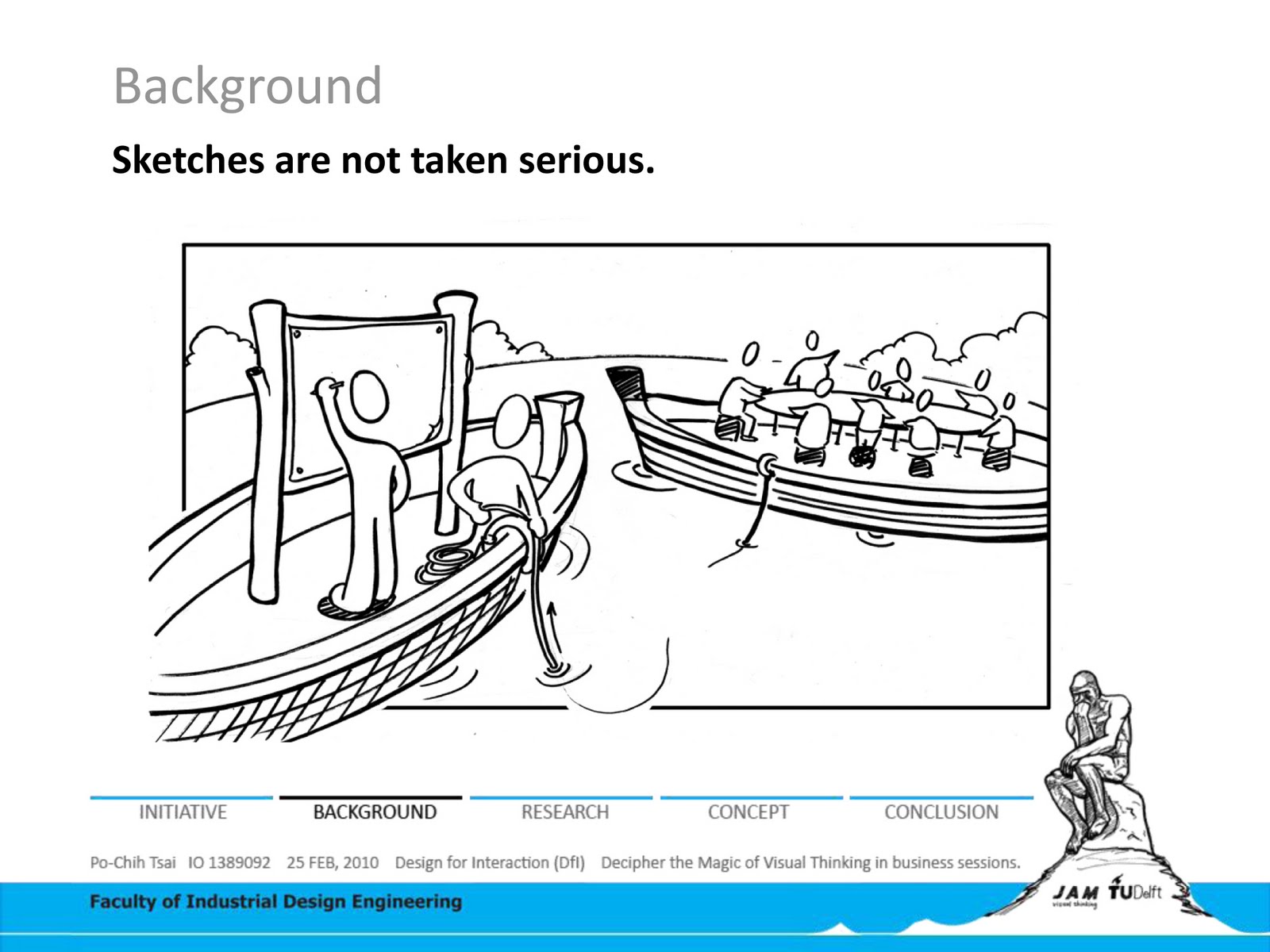
However, JAMmers usually are treated as a supporting and entertaining role in sessions. They cannot be involved in the problem solving process. They are not working with the participants on the same boat in general situations. So, what are the reasons behind the issue?


In order to address the issue, we have to know the reasons behind it. In 1972, Rudolf Arnheim, a German-born psychologist and scholar of art and ideas. He suggested in his book, "Visual Thinking", that the issues was rooted early in the history.


Thousands of years ago, Greek philosophers learned to distrust the senses, but they never forgot that direct vision is the first and the final source of wisdom. In the words of Aristotle, “The soul never thinks without an image.” At that time “Visuals” and “logical thinking” work harmoniously in a lively cycle.


However, Rudolf Arnhim also pointed out that “Visuals” (art) and “Logical thinking” (science) have been torn apart for a long time. Since people have been taught that “only words and numbers matter” and “drawings are art but not science.”


This situation didn’t change a lot until the middle of 20th century, when Visual Thinking started to bridge the gap in the context of business sessions.


Beginning from using flip charts inn sessions in 1950s, the idea of instant visual recording in front of session participants was applied in 1970s. The innovation of computers provided fresh possibility in ways of facilitation in 1980s. Big group was involved later in 1990s.


I also learned that the missing puzzle of the bridge is still hidden behind the cloud of an unclear Visual Thinking process.


To clear the cloud in Visual Thinking process, I studied the benefits, techniques, theories about Visual Thinking process in academic literature and publications of visual practitioners. The figure above is the visual description of the results. (Or see the previous post)


I also learned from JAMmers's experience that "Drawings should not just surprise people only in their first sight but also keep inspiring people to see the structure, problems, and solutions." I assumed that this is the ultimate goal of Visual Thinking in group sessions.


However, it is also suggested in the experience of JAMmers that these well-developed techniques cannot always guarantee the ultimate goal of Visual Thinking.


It is implied that the missing puzzle is the intense human interactions between Visual Thinkers and participants in sessions. The human interactions are the key to understand people's expectation and desire and to drive them to proper direction. (Or see the previous post) But there is no much study about human interactions in the field of Visual Thinking so far.

Therefore, the following research of the graduation project was dedicated to carefully map the human interactions in the context of Visual Thinking sessions. This would be a crucial step to decode the Visual Thinking process and optimize Visual Thinking method.

Thursday, January 14, 2010

Further Interpretation About Visual Thinking Processes in Sessions

This drawing above depicts Visual Thinking processes in sessions: to reach hidden insights deep in people’s minds, come to shared visions and solutions, and finally realize the ideas in practical actions in Visual Thinking sessions. Different from the post: Does the Flow Run only on the Surface or Deep in Minds?, an extended explanation about realizing shared visions into actions is added in the drawing. This conceptual framework in the drawing can therefore be categorized in four major processes and five main stages (See the drawing below).

According to different features in Visual Thinking process, the five major processes are named: Grounding, Diving, Showing, Lifting, and Landing. The four main stages are named: Common Ground (Shared Mental Models), Personal Insights, Shared Visions, and Action.
The five major processes
1. Grounding
In a multi-disciplinary group, Visual Thinking can help to build shared understands in which people can communicate on a common ground. Visual Thinking in this process provides a common language (visual language) and works as a catalyst to create a fluid thinking flow. This process also includes the preparation before the sessions.

2. Diving
Visual Thinkers in this process dive with people to gain the personal insights. Visual Thinkers concentrate on all information they can detect in the process and help participants to gain deeper insights with instant sketches.

3. Showing
Visual Thinkers visualize the personal insights to bring it to the stage, “Shared Mental Models”, where people can really see and discuss each other’s ideas. As a result, the insights can be discussed and be built on with others’ ideas.

4. Lifting
The “Shared Mental Models” can be leveled up to the stage, “Shared vision” through the transformation in Visual Thinking, for example, to give a proper metaphor to describe a potential crisis in the market.

5. Landing
After a team forms a shared vision, the shared vision needs to be developed into a down-to-earth solution. In this process, Visual Thinkers will work with the clients closely to finalize the realistic solution. The “Landing” process can last longer after the session ends.

The four main stages
1. Common ground (Shared Mental Models)
Multi-disciplinary groups need to form shared Mental Models (Common ground) to communicate. The stage is the foundation for a group to talk and work together.

2. Personal insights
The stage, “Personal insights”, is where people’s personal ideas and thinking lie on. The drawings need to connect to people’s personal ideas. Visual thinkers have to work on detecting people’s real thinking and try to associate the different insights with each other.

3. Shared vision
“Shared Vision” is the stage where people share coherent ideas about the issues of the session. This vision is a higher level concept of the shared Mental Models, such as a shared future strategy to an issue. Shared visions in a team take more time to transform and develop in order to reach the core of issue and provide clear motivation for “Action”, compared to shared Mental Models.

4. Action
This stage, “Action”, is where people realize the shared vision in a practical plan. One of the purposes in the Visual Thinking is to eventually create new thinking with drawings which triggers people to action. However, having shared Mental Models is not enough to trigger radical or lasting actions for an organizational change. People need clear motivation with the shared vision.

Sunday, September 6, 2009

Barricades in the Way of Thinking Flows and Ways to Deal with Them

We have discussed the reasons why more issues should be explored further in the previous post. Here is the first issue. We need to explore the types of barricades happening in the process which block the thinking flows. If they cannot fully solve the problems happening here, that would be definitely jeopardizing to the contributions of VT/GF.

I assume that, for different individual Visual Thinker/Graphic Facilitator, the techniques will alter depending on their personalities, their backgrounds, and the real situations which are the composition of the team, the environment, etc. We need to ask: What kind of preparation will Visual Thinkers/Graphic Facilitators do before the sessions? How do they deal with the barricades in the process? Will they pump into more energy to break them through, or use special skills to jump over them, or simply make a new path to bypass?

Does the Flow Run only on the Surface or Deep in Minds?

We have discussed the reasons why more issues should be explored further in the previous post. We discussed the first issue: barricades in the way of thinking flow. It is also interesting to know that, even though VT/GF is to create a fluid thinking flow, the flow is just running on the surface, or it can run deeper to bring out profound insights, which is truly the goal of VT/GF.
On the one hand, without in-depth insights being aroused, the drawings will be disconnected with participants and become meaningless no matter how beautiful they are. These drawings in the process, in the case, are not working as catalysts. In terms of the results, the disconnected drawings will not showcase valid findings in sessions and cannot lead stakeholders to the vision they want to bring.

On the other hand, one of the unique features of VT/GF, “Speeding up by slowing down first”, is a proper example to represent the benefits of running deep. It will take some time to get in-depth insights in the thinking process until people get enough insights. However, if the flow is too fast, people will simply drift fluidly on the surface to the end. This efficient process will not guarantee a thorough solution because the process is not reflective to every one’s thoughts in mind. The final result in this case functions as a “decoration” rather than a “transformation” (see Visualization helps learning).

For Visual Thinkers/Graphic Facilitators, their experiences on this issue will be elaborated in the angles of what kinds of factors affect most, how Visual Thinkers/Graphic Facilitators evaluate the process, and how they evaluate the outcomes. For clients, their feedback will be asked and evaluated in case studies.

Issues Need to Be Explored in the Following Researches.

This theoretical framework of Visual Thinking/Graphic Facilitation represented a model under ideal situations in sessions. However, we still need to know more about how Visual Thinkers/Graphic Facilitators react to the setbacks which block or stagnate the creative thinking in process, and what kind of factors will affect most when things go wrong. Many facilitation techniques already focus a lot on the implementation of icebreakers in multi-disciplinary teams, and the techniques to develop proper Infographics to report the results. There are also many how-to-do tool books in Visual Thinking/Graphic Facilitation, but there is still lack of researches on limitations of VT/GF and solutions to them in the progress.
There are other issues with a value to apply further researches. First, what are the barricades in the way of thinking flows and ways to deal with them? Secondly, is the thinking Flow running on the surface or deep in minds? A further explanation to these two issues will be given in the following sections.

Saturday, September 5, 2009

How does Visual Tinking help people in sessions?

This table demonstrates a quick comparison of Visual Thinking Process, Visual Design Process, Techniques in Visual Thinking/Graphic (VT/GF) Facilitation Sessions, and Benefits in VT/GF Sessions in terms of time passing by in sessions. It suggests that Visual Design Process (JAM visual thinking, 2009) in VT/GF is developed on a simple and basic individual Visual Thinking Process (Roam, D. 2008). Visual Design Process is a group-level thinking process which inherits the intuitive nature of individual Visual Thinking Process. Participants as a group in the sessions can process the information in their minds as they have done numerous times in daily time.

Visual Thinkers/Graphic Facilitators also follow similar pattern to make a good use of appropriate techniques in each stage of Visual Design Process. For example, they use “Observation skills” to collect relevant and/or subtle information in the discussion. They quickly select out all these elements and draw them in front of participants with the technique, “Fast catch: word and image”. “Observation skills” and “Fast catch: word and image” create a common ground for “Collecting elements” and “Finding coherence”. As time goes by, the technique, “Deep listening: story and metaphor” help participants to compose of the words and images into coherent stories and/or metaphors as the base of “Composition”. “Holistic reflection” finally paves a way for Visual Thinkers/Graphic Facilitators to create a living document which is based on Team Mental Models or shared understanding in the sessions.

Visual thinking process is non-linear and non-rational, which is a proper ground for breeding creativity. Eventually, the thinking flow empowered by VT/GF techniques will bring fruity benefits to individual participants and teams in the sessions, and to stakeholders and employees after the sessions.

Wednesday, July 29, 2009

6 Ways of Seeing, by Dan Roam.

We see a number of things before we start to think. Actually, it all happens in a split second, and you don't even notice this.

We can see more than what we really “look at”. There are the “low-level” cognitive processes which take place when we receive numerous inputs and react to them without going through all over the complex brain. We filter out things and focus on something worth looking at because the “low-level” mental process enables us to act even before we think.

In "the Back of the Napkin", Dan Roam explained the pre-cognitive visual attributes as the six ways of seeing, in which he argued that people distinguished “who”, “what”, “how many/much”, “where” (positions of objects), and “when” (changing of positions) almost intuitively in a given scene, and defined “how” things influence each other and “why” in a later thought.

Understanding the potential of how our brains work in visual thinking paves a way to make a good use of them.

Tuesday, July 28, 2009

History of Visual Thinking, by Christine Valenza and Jan Adkins.

In their newly-released paper: Understanding Visual Thinking: The History and Future of Graphic Facilitation, Christine Valenza and Jan Adkins (2009) described the nowadays global economy model with a metaphor: the neuron, compared to a vertical ladder in the Middle Ages and a flat web in the industrial age. They further explained the idea that modern people deal with the complex world by near-instant communication plugging into all levels of a problem and with multiple variables . The nonlinear thinking process for human ingenuity and creativity is rather like a human’s neuron networks than a machine.

From linear and vertical ladder to a complex neuron system, people started to be aware of the voices outside a hierarchy and tried to involve expertise with no manufacturing and commercial background, such as psychology, social science and biology. The flip chart in 1950s was probably the most well-known tool for presenting ideas and recording process in a meeting. People developed the flip chart as a more elaborate VT/GF tool with knowledge of Gestalt awareness, corporate learning, group dynamics, mind maps etc. Therefore, the poster in the front of a group in a conference could record a propound view with assembled graphics, numbers, and arguments.

In 1970s, the concept of a facilitator actively leading meetings toward conflict- and problem-solving interactions emerged with the influence of David Sibbet’s large-paper approach or Michael Doyle’s flip charts recording running dialogue, augmented with large infographic images.

In 1980s, the emergence of computer networking and the internet triggered the interactive graphics to support group process. During the period, people realized that corporations were similar to human entity, subject to more complex motives, stressors, and failures. In 1990s, many business management consultants developed large-scale change methods to involve wider groups of stakeholders in the process of creating fresh decisions.

VT/GF in 21st century now takes advantages of the convenient social networking device and on-line program and still makes a good use of efficiency and accessibilities of the conventional tools, such as hand drawing skills, big poster, and markers. Visual Thinkers/Graphic Facilitators also use fresh visual language, a knowledge of group dynamics, and contemporary business and meeting process awareness.


With a thorough introduction of important publications, facilitation theory, and key figurers, this paper leads us to go through a clear context of the history of Visual Thinking. This is really valuable to understand fundamental background knowledge in Visual Thinking.

In the paper, you can find a better and detail description of the History of Graphic Facilitation with Cristine's and Jan's extraordinary insights. Enjoy it!

Friday, July 17, 2009

What is Visual Thinking Process?


This poster is my first step to decipher the Visual Thinking Process. They are originated from JAM as a concept to describe Visual Design Process.

The four steps in Visual Design Process are "Collecting elements", "Finding coherence", "Composition", and "Translation". People shift from one step to another following the flow of thinking. Visual thinkers use multiple techniques to smooth the flow of thinking in a given meeting. The flow breeds abundant benefits both in the process and final result. Please click on "read more" if you want to get more explanation.

1. What is Visual Thinking Process?

Through
Visual Thinking, people can solve complex problem in the process. However, what happened in the process is something needs to be deciphered if we want to make a good use of Visual Thinking. I am going to explain the process of Visual Thinking, Visual Thinkers' techniques, and benefits of Visual Thinking in the following pictures.

2. Visual Thinking Process Creates a Flow:
In visual thinking process, there are four steps: "collecting elements", "finding coherence", "composition", and "translation". Collecting elements is when people try to explore and lay out all helpful data on the table. Finding coherence is when people start to find out linkage between data and cluster them. Composition is to figure them out in a bigger and logical scale. Translation is to transfer the result in composition with a meaningful metaphor which can motivate and inspire people in the end.

3. Underlying Flows in Visual Thinking Process:
The process is non-linear and non-rational. The underlying flows in the picture indicate that the process can shift from one loop to another. Instead of running in a linear an one-way route, it is more like cycling in each loop when people try to get more in-depth insights.

4. What do Visual Thinkers Do in the process?
Visual thinkers use multiple techniques to help the flow smooth. People can think more fluid and, instead of being pushed to next loop, slow down their thinking. People can therefore stay in a loop longer until they get enough insights.

5. Benefits of Visual Thinking:
In the process, visual thinkers' techniques help create common ground in a team, which bring benefits both in the process and the result.

The picture is an initial exploration of the power of hand drawing in facilitation workshop. I will try to make it more elaborate in the latter phase of the graduation project. Please feel free to give comments for me to improve them.

Thursday, July 9, 2009

"The Back of the Napkin", by Dan Roam

This is a book about visual thinking in an everybody-can-do-it way. With a pen, a piece of napkin and your bare hand, you are already equipped enough to solve all of the problems you can image even they are as complex as a modern business problem. The drawing power has manifested itself in this book with a series of interesting and meaningful stories and, of course, a lot of illustrations.

One of the best thing I learned here is that, even though you think you can't draw, you can still use the visual thinking as a powerful problem-solving tool. As a reader, you can easily tell how complex business problems can be solved with such simple hand drawings. And there is no magic in this process. Everyone can simply follow Dan Roam's guides in the book to start their own visual thinking adventure with no burden.

In this book, another interesting thing I found is the four steps of visual thinking process, which are "Looking", "Seeing", "Imaging", and "Showing". "Looking" is like you browse through the room when you step in a party. "Seeing" is like you notice some familiar faces. "Imaging" is that you think what will happen if you go to them. "Showing" is to choose one girl you know to go to because you are most willing to do so. I think here the four steps of visual thinking process are the basic principles I am looking for. I always believed visual thinking is indeed originated from some really basic and simple principles, which are "built-in" in human beings.

Again, there is no magic. However, we need this kind of book to make us be aware of this "built-in" super power, or we just waste our natural talents.

Check out the short introduction video on youtube. Or a longer presentation given by Dan Roam about "the Back of the Napkin".

Last but not least, it is so interesting to see underlying connections (or similarities) between Dan Roam's Visual Thinking Process and Visual Design Process in JAM visual thinking. Just like the picture above, "Collecting elements" is "Looking". "Finding coherence" is "Seeing". "Composition" is "Imaging". "Translation" is "Showing". It is so evident that the visual thinking process described here really makes sense in both personal experience and real practice. This is indeed a simple, basic principle lying in our nature.

There is also a Chinese (Traditional) version: 餐巾紙的背後 available in Taiwan now.